Saturday, 29 June 2019

Gaufres Flamandes

Flemish Waffles
Makes about 40 to 50 waffles, depending on size

For the gaufres (waffles):
250g plain flour
20g golden caster sugar
2 eggs
75g butter, softened 
100ml milk
2.5ml vanilla extract
7.5g sachet dry yeast
tiny pinch of salt

For the filling:
125g butter
250g dark brown soft unrefined cane sugar


Method:

Warm the milk until it is tepid. Add the caster sugar, vanilla and yeast.

Pour the flour into a large bowl and make a well.  Gradually add the milk mixture, kneading to avoid lumps. Add the pinch of salt, eggs and soft butter. Knead several minutes to form a nice ball of dough. Cover with a clean cloth and let stand for 2 hours at room temperature.

While the dough is resting, prepare the filling: Whip the softened butter with the brown sugar until you obtain a homogeneous cream and set to one side.

Kneed the dough, adding a little more flour if too sticky, to a smooth dough.  flatten out and cut with a sharp knife into 40 to 50 pieces.  Roll in floured hands to form balls.

balls of dough to the fore and split waffles on a cooling rack behind
Dough balls and split waffles
Heat your waffle iron. Take balls of the dough and place them on the bottom plate of your waffle iron. Close and cook for two minutes.  Remove the cooked waffles and cook the next batch. While those are cooking, split each cooked waffle in half with a sharp knife, ready for filling.  Repeat the process until the dough is gone.

Fill each waffle with the paste of the butter and brown sugar, or use another filling - I find Biscoff crunchy spread works very well.  Press down firmly.

Indulge as you see fit.


A tower of Flemish waffles filled with Biscoff crunchy spread
Tower of waffles filled with Biscoff crunchy spread


Monday, 8 October 2018

Quince Marmalade

Roll over Seville orange and make way for quince.  My new favourite ingredient for marmalade is not new at all.  It was the principle constituent in the original marmalades.

The resulting marmalade is cheek-tinglingly tasty.  Here's my recipe for about 24 x 190ml jars:

Ingredients

2.4kg quinces
600g lemons
1.5 litres water
2.5kg sugar

Method

Halve the lemons lengthways and slice as thick as you like the shreds in your 
marmalade, then place in the jam pan with the water. 
Quarter the quinces, remove the cores and slice like the lemons. Put the slices in 
the jam pan and put the cores, tied up in muslin, in the pan as well. 

Bring to the boil and simmer for 45 minutes.
Remove the bag of cores, squeeze the pectin rich liquid out of it in to the jam pan. 
Add the sugar and boil to setting point.  

This shouldn't take too long. Test by placing a spoonful onto a cold plate (keep a 
few handy in the freezer in advance) and after a minute, push it with a finger. If the 
surface wrinkles then it is done.
Remove from the heat and allow to cool for a few minutes. This allows the 
marmalade to begin to set so that the fruit and rind doesn't settle too much when 
poured into the jars. 
Sterilise clean jars and lids by placing in an oven at 130°C for ten minutes. 
Pour into the jars and put the lids on. 

Sunday, 15 November 2015

Nutella Bread and Butter Pudding

Serves four and fits in a 12cm X 18cm gratin dish. Double-up if needed for a larger dish. 

Ingredients 
4 slices of dry, medium sliced, white bread
Softened butter
Nutella
150ml milk
15g caster sugar
1 egg
1/2 tsp vanilla extract 
1 tsp demerara sugar

Method
Make two sandwiches of the bread, buttered on the outside and just Nutella on the inside, thickly spread.
Cut off the crusts and cut each‎ sandwich into four triangles then arrange in a buttered gratin dish. 
‎Beat together the milk, egg, caster sugar and vanilla extract. 
Pour over the sandwiches. 
Sprinkle with demerara sugar. 
Bake for 20 to 35 minutes, until golden brown on top, at 160C (fan oven)

Sunday, 5 July 2015

White & Dark Chocolate chip Banana Muffins

‎Makes 24 muffins (halve all quantities for 12 and keep same cooking time)

Ingredients


400g plain flour
100g wholemeal flour
200g caster sugar
1tsp sodium bicarbonate
2tsp baking powder
250ml rapeseed, sunflower or vegetable oil
4 eggs
6 over ripe bananas
200g dark chocolate chips
100g white chocolate chips
(US conversions below)


Method

In a large bowl: Mix together the two flours, sodium bicarb, baking powder and sugar. 
Beat the oil and eggs together and add to the dry mix. 
Mash the bananas and add the bowl.
Mix. 
Fold in the chocolate chips. 
Divide the mix between muffin cases in a muffin tin.
Bake at 200C / 180C fan / Gas 6 for about 20 minutes. 
Leave to cool. 

NB

Dividing between the muffin cases is probably the trickiest step. I've tried using serving spoons, scooping with little pudding moulds or ramekins, but, inevitably, ‎you often get some mix glooping onto the tray instead of falling neatly into the muffin cases. This mix usually fills your average muffin cases to about a centimetre from the top. 

You can use all one type of chocolate chip in this recipe or all plain flour. I originally introduced the wholemeal flour because I didn't have quite enough plain, but it ‎gives a nice nutty note to the taste.

US / Imperial units:

Bake at 400F
14oz plain flour
3½oz wholemeal flour
7oz caster sugar
1tsp sodium bicarbonate
2tsp baking powder
9fl oz rapeseed, sunflower or vegetable oil
4 eggs
6 over ripe bananas
7oz dark chocolate chips
3½oz white chocolate chips

The method is shown in this video:

Admittedly, this video shows me taking the short-cut of using self raising flour (cake flour) with works quite well, but they rise a little less.

‎https://www.youtube.com/watch?v=TizuS0qs7ao

Saturday, 29 November 2014

Stollen Recipe

Stollen

Ingredients 1

500g strong white bread flour
100g caster sugar
1 sachet fast action yeast
10g salt
150g soft butter
250ml full fat milk

Ingredients 2

2 tsp mixed spice
grated zest of 1 lemon
1 tsp cardamom seeds
1/2 tsp vanilla extract
30ml amaretto
100g blanched almonds
200g raisins / currants
125g mixed peel
1/2 tub glace cherries

Ingredients 3

225g melted butter
400g marzipan

Ingredients 4

25g melted butter
icing sugar

Method


  • Mix ingredients 1 to a dough.
  • Mix ingredients 2 in a bowl then place the dough on top.
  • Kneed the dried fruit and spices into the dough.
  • Cling film and leave to double in size.
  • On a lightly floured top: form the dough into a 16 inch square.
  • Brush the top with melted butter (ingredients 3).
  • Form the marzipan into a 16 inch by 10 inch rectangle.
  • Place in the middle of the dough with a 3 inch border, top and bottom.
  • Roll the dough up from bottom to top.
  • Cut the rolled dough into 3 equal lengths.
  • Leave to rise for an hour.
  • Bake the loaves for 45 minutes at 170 C fan / Gas 5 / 190 C conventional.
  • Brush with melted butter and dust with icing sugar.
  • Leave to cool.

Wednesday, 7 May 2014

Baked Creamy Egg in a Crispy Cup

baked egg

This is a quick and tasty way to cook egg. It's similar to cottage eggs, where the egg is baked in a ramekin without a bread lining, which is still delicious, but you have baked-on egg to contend with when washing up.

Ingredients (per egg)


1 egg
1 slice of bread
butter
2 tsp double cream
1 grind of salt
1 grind of black pepper

Method


Cut the crusts off the slice of bread and roll flat with a rolling pin.
Spread with butter.
Push the bread, butter side down, into a ramekin dish or a muffin tin.
As you push the bread down, folds of bread will form.  You can just press these to the edges.
If you make any holes in the bread as you press it into the tin, rip off a little bread from the top and press it down over the hole.
Crack in one egg.
Season with salt and pepper.


Add the cream.

Bake for 15 minutes at 180 C.

Serve.

My kids love these.  Some eat them with their fingers, some eat them with a spoon, before eating the bread cup.  Come to think of it, I love these with a salad for a lunch or light dinner.

You could vary the seasoning of the egg to your personal taste.  Perhaps some finely chopped parsley or smoked paprika.


Sunday, 20 April 2014

Quick Flammekuchen, tarte flambee

I believe tarte flambée, or flammekuchen, is a dish from the Alsace region.  Traditionally a thin leavened bread topped with crème fraîche, onions and bacon lardons, then baked in a wood fired oven.

This quick recipe I improvised one lunch time when there was not much in the fridge for lunch, save for an open pack of ham, crème fraîche and a small onion that my son had brought back from a gardening club at school.  Traditionally, I assume the bread would be leavened with yeast, but this quick version uses self-raising flour.

For the base

Self raising flour, a heap the size of a tennis ball.
Pinch of salt
Half a teaspoon dried mixed herbs
A glug of garlic infused oil, say about 2 tsp
Enough cold water to make a soft dough.

Don't worry if you add a little too much water and the dough is sticky, just add a little more flour until the dough stops sticking to your hands as you work it.
Roll out the dough to an oval or oblong shape to a few millimeters thick.

For the topping

Spoon on a tablespoon or two of crème fraîche and spread evenly with the back of the spoon. Sprinkle with a chopped shallot or small onion. Chop up ham and scatter on top, or use bacon lardons.

Bake at 180 - 200 C for about 10 minutes.

Sunday, 1 December 2013

Snowball pudding

A family food tradition at Christmas from my wife's side of the family, I was smitten with the first spoonful and was keen to keep this tradition going.  Far simpler than a standard Christmas pud and less heavy.

Ingredients

11 oz can mandarin oranges
2 oz sultanas
2 oz raisins
2 Tbsp sherry (Harvey's Bristol Cream)
3 oz glacé cherries
4 oz butter
4 oz icing sugar
2 oz ground almonds
8 trifle sponges
2 Tbsp milk
5 fl oz double cream

Method

Lightly butter a 1 pint pudding basin.
Drain mandarins.
Place sultanas and raisins in a small bowl and add the sherry.
Cut the cherries into quarters and chop the mandarins.
Cream the butter and icing sugar until light and fluffy.
Fold in ground almonds and cherries.
Crumble in the sponges and fold in the mandarins, sultanas, raisins and sherry.
Place this mixture into the buttered pudding bowl, pressing down firmly and levelling the top with the back of a spoon.
Cover with foil and chill in the fridge for up to 4 days.
Remove from the fridge and uncover.
Run a knife round the top and dip in warm water for 30 seconds before upending onto a serving plate.
Whip the cream and cover the pudding to look like a snowball.
Serve as is or decorate as you like.

Merry Christmas!

Tuesday, 13 August 2013

Tarte aux Pruneaux

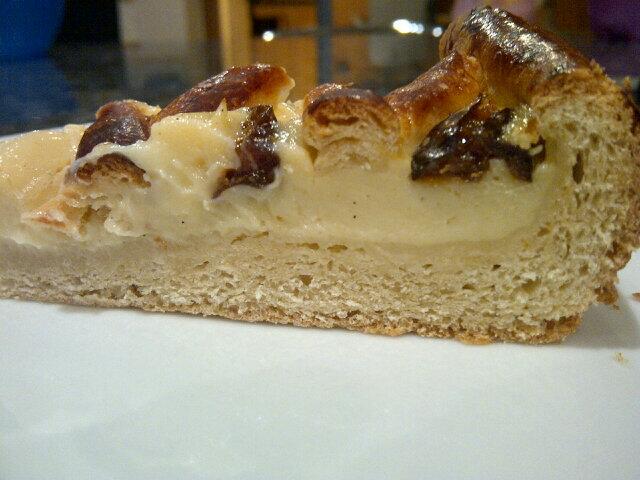
tarte aux pruneaux recipe
I was so taken with this tart when I bought one from a patisserie in the north of France, that I quizzed the baker on how to make it.  The leavened pastry (pate levee) takes a little time to make, with all the resting stages, but I think it is well worth the wait.  Best served once cooled to room temperature.

Times

about a total of
20 mins work,
2 hour 40 mins resting,
30 mins baking

Ingredients

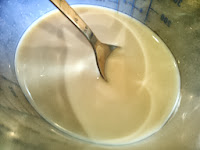
fresh yeast in warm milk
250g plain flour
80g warm milk
15 fresh yeast
1 egg, beaten
25g caster sugar
5g salt
100g soft butter
1 pint pastry cream (creme patissiere)
Partially rehydrated prunes
milk and yeast being added to flour

Equipment

25cm (10 inch) cake tin
Rolling pin
Mixing bowl

egg into flour Method

Dissolve the yeast in the warm milk
and add to the flour in a bowl, then start mixing.


Add the egg
Then the sugar and salt.
Continue to mix with a dough hook or kneed to a dough.

Leave to rest at room temperature for 10 minutes.

role out pastry to an inch beyond tin size
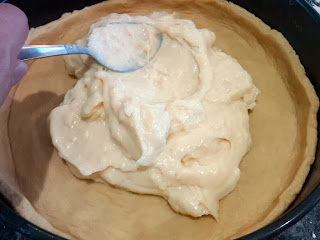
spread out pastry cream
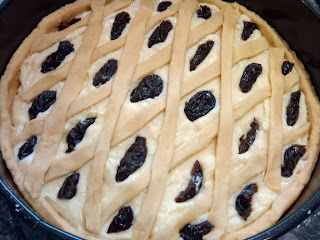
push prunes between lattice work
Add the soft butter and kneed in as best you can. The dough may seem like it's disintegrating and not likely to recover, but keep kneeding away. Eventually the dough will come together and come away from the work surface quite nicely.

Cover and leave to prove at room temperature for an hour.

Transfer to the fridge for half an hour to firm up the dough.

Mould the dough in your hands to an even shaped disc then roll out on a floured surface to about 3mm thick.

Place the cake tin on the pastry and cut a disc around 3cm wider than the tin edge.

Line the tin with the pastry allowing the excess to form the sides of the tart.

Fill with a pint of Creme Patissiere and spread evenly over the base.

Use the off-cuts of pastry to form a lattice work and push halves of partially rehydrated prunes into the creme patissiere between the latticework.

Leave to prove for an hour.

Brush the pastry with beaten egg.

tarte aux pruneauxBake at 180 C for 10 minutes.

Reduce the heat to 150 C for 20 minutes.

Leave to cool and serve at room temperature.


If you wish to see a video of me making the pastry, this time for a plain tarte a la creme, there is a YouTube video, below.


and to make the creme patissiere, here's another video:


Wednesday, 12 June 2013

Granola

60ml vegetable oil
130ml maple syrup
60ml honey
1 tsp vanilla extract
300g rolled oats
100g pecans, roughly chopped
100g almonds, roughly chopped

Mix the oil, maple syrup, honey and vanilla in a large bowl. Add the remaining ingredients and mix..
Tip this mixture onto two baking sheets and spread evenly. Bake for 25-30 mins at 140C.
Leave to cool then transfer to a kilner jar or other airtight container, it should break-up into "clusters" as you transfer it.

This is also a great way of using the crushed up bits of purchased cereal left in the bottom of packs, just add to the mix reducing the amount of oats by the weight off added cerials:

Friday, 7 December 2012

Pancetta and Parmesan Pasta with savoury custard


I've cooked this quick and simple dish for years and referred to it as Carbonara, but if you want to be pedantic, and many people do, it's not a traditional Carbonara. As I understand it, it would not traditionally contain cream. I'm all for respecting tradition, but this recipe is so popular with my family, that I shall continue to incorporate cream into the dish, but will not claim it's pasta carbonara.

Ingredients


1 pack of lardons or pancetta cubes

3 eggs

Handful of freshly grated parmesan


Double cream 60 to 80ml

Grind of black pepper

Pasta for 2 people


Method

Place the lardons in a dry, non-stick pan over a medium heat. As the fat on the lardons heats up, it liquifies and cooks the meat. When cooked to a deep colour and crisp, remove from the heat and save for later.
Start cooking the pasta.


Break the eggs into a bowl and add the parmesan, cream and a grind of pepper, then mix together with a fork.

When cooked, drain the pasta and return to its, still hot, saucepan. Add the creamy muixture and the reserved crispy lardons and stir over a medium heat. In a traditional carbonara the sauce would cook in the heat of the cooked pasta, but we need heat here to thicken what is effectively a bacon and parmesan custard. Keep stirring until the sauce thickens and clings nicely to the pasta.
Serve into warmed pasta bowls and consume greedily with a glass of robust white wine.


Saturday, 24 November 2012

Strong Ginger Beer

This will produce a small batch (5 litres) of strong (~7%abv) warming ginger beer, not as sweet as Crabbies Ginger Beer but richer in maltiness.


Ingredients

1kg of dark or medium, dry malt extract (or 1.3kg of liquid malt extract)
300g root ginger
500g honey (optional, but will up the strength to nearer 8%)
Sachet of Ale Yeast

Method

Cut the ginger into small pieces and bash in a pestle and mortar (or in a freezer bag with a rolling pin)
Boil a litre of water in a large saucepan and add the bashed ginger and the malt extract.
Stir on a high heat until the malt has dissolved, it may form clumps until the water gets hot enough.
Once boiling and all the malt has dissolved, remove from the heat and add 4 litres of cold water, if using honey then add just before the cold water.

Please note: after boiling is over, any equipment coming into contact with this brew should be sanitised and this can be performed with a range of products from a home brew shop.  If you can't get to a home brew shop, you could use a product for sanitising babies' bottles, but if you can't get to a home brew shop, you will probably also need to compromise on two other key ingredients by using bread yeast and ordinary malt extract.  It will still work using these ingredients but the finished beer will not be quite as fine as if ale yeast and brewing grade malt is used.
Check the temperature, if above 22 C, place the pan in a sink of running cold water, stirring until the temperature comes down to a level that the yeast can cope with.  This is usually stated on the pack of yeast, but for an ale yeast, this is typically 18-22 C.  The stirring will serve to speed the cooling process and, if robust enough, will help aerate the malt solution (known as wort in brewing terms, pronounced "wert") dissolving gasses lost from the solution when boiled; An aerated wort is a better environment for the yeast to start-off in.
When at the right temperature, pour the wort into a sanitised fermenting bin.  The fermenting bin or bucket is a food grade plastic bucket, but you can use a container of any food grade material, such as a glass demijohn or carboy.  Sanitisation cleans the container to a level where there is near-as-dammit no microbes present to compete with the yeast for colonisation of the wort that is about to fill the bucket.
Once in the fermenting bin, add the yeast and stir vigorously for a minute to give the yeast a kick start.  Place a lid loosely on the bucket, to prevent anything falling or crawling into the beer but not sealed, so the carbon dioxide gas produced from fermentation can escape.  A sealed container would swell with built-up pressure and eventually blow making quite a mess.  If desired, you could use a container fitted with a bubble trap which allows the gas to escape and better protects the beer from ingress of anything else, but this is not absolutely necessary - I hardly ever bother.  However, the bubble trap will give you an indication of the progress of fermentation:  the frequency of bubbling slows right down then stops when fermentation is over.
After a couple of weeks or when the fermentation is over you are ready to bottle the ginger beer.  To be sure the fermentation is over, you should use a hydrometer and when the reading is low enough and stable for a few days, you can bottle.
As ever: sanitise bottles and equipment.  If using a syphon tube, make sure the bits of ginger won't block it, by using an attachment that sits on the base of the fermenting bin that won't block, or by attaching a small piece of muslin cloth to the end of the tube.
Prime each bottle with household sugar at the rate of one teaspoon per litre of beer.  Seal the bottles and leave at room temperature for a week for the sugar to be fermented to alcohol and carbon dioxide.  Then leave in a cool or cold place for a few weeks for the carbon dioxide to dissolve in the beer, to carbonate it.
If you are unsure if the beer had fully fermented before bottling, use plastic bottles.  If they blow, they will still make a mess, but not quite as scary as exploding glass bottles.
When ready to drink, handle the bottles gently so as not to kick-up the sediment and pour in a slow and smooth single motion, with light behind the bottle so you can see any sediment that may come with the last bit of the beer in the bottle.
Sit back and enjoy the beer, the maltiness and ginger giving a warm feeling on a cold day.


Friday, 16 November 2012

Chocolate Cream Pies

As a child I had a penchant for those clear pots of smooth chocolate dessert topped with sweetened whipped cream. To be honest I could happily demolish one now, but here's my version in pastry cases:

cream topped chocolate pies

For the pastry cases


Ingredients

4oz plain flour
Pinch salt
2 tsp sugar
2oz butter
30ml or more of cold water


Method


Place the flour, sugar and salt in a mixing bowl.
Cut the butter into small dice and rub into the flour with finger tips.
Once it all looks like fine bread crumbs, add 2 tablespoons of water and bring together with a butter-knife to start forming a firm dough, you may need a tad more water if it doesn't start coming together. Form a ball of dough in your hands, cover in food wrap and place in the fridge for half an hour.
Roll out the pastry on a floured surface to the thickness of a penny.
Cut out discs with a cm pastry cutter and carefully place the discs in a greased muffin tin, reforming the dough, rolling out and cutting again until you have 12 discs (there is only just enough pastry to do this)
Oven fired up and set to gas mark 5.
Place the lined muffin tin in the fridge while your oven heats up, this should stop the pastry shrinking when it is baked.
Bake in the oven for 7 minutes then remove from the oven, brush with egg wash (egg yolk with a dash of milk) pushing back any pastry that has ballooned up.
Return to the oven for a further 14 minutes.

For the filling


Ingredients

2 Tbsp Cocoa powder
1 heaped tsp instant coffee (optional)
1oz Cornflour
2 Tbsp Milk
15 fl oz Milk
Sugar
Butter

Method

Slake the cocoa and cornflour (and possibly the coffee, decaff if preferred) with the 2 tbsp milk.
Heat the 3/4 pint milk to boiling then whisk into the cocoa paste and place in a pan and boil for 2 mins, whisking.
Heat off.
Whisk in 1oz butter and 4 tbsp caster sugar.
Whisk for 2 mins.
Pour into pastry cases.
Cool over night.

For the Chantilly Cream topping

Ingredients

10 fl oz Whipping cream
2 tsp icing sugar
2 tsp Amaretto (optional)
Part of a small bar of chocolate

Method 

Whip the cream, then add the icing sugar or use only 1 tsp icing sugar and add the Amaretto liqueur before whisking again.
Pipe the cream onto the pies and grate chocolate over the top.

Friday, 9 November 2012

Lemony Butter Biscuits


Makes: 2 lots of 18-20 biscuits
Prep time: 10 mins prep then 30 mins fridge plus 2 hrs more fridge time or over-night
Cooking time: 20 minutes
Skill level: Piece of pith
Equipment:  Mixing bowl and wooden spoon / food mixer; zester or fine grater; Sharp knife; cling film; baking sheet; cooling rack

Ingredients


175g Butter (unsalted)
Zest of a whole lemon
lemony butter biscuits50g Caster sugar
50g Demerara sugar
1/2 tsp Vanilla extract
225g Plain flour

To coat
100g or so of Demerara sugar

Method

Beat the butter until soft and creamy.
Mix in the zest, caster sugar, Demerara sugar and vanilla and beat until light and fluffy.
Sift in the flour and mix / bring together the dough.
Lightly kneed the dough until smooth (a matter of seconds should do)
Divide into two, wrap and refrigerate for 30 minutes.
Shape each piece of dough in to a 15cm long cylinder and roll in the Demerara sugar to coat before wrapping in cling film and refrigerating for at least 2 hours.
I normally put one cyclinder in the freezer for another day.
Once out of the fridge or defrosted slice 15 discs (1cm thick) and place on a baking sheet about 2 cm apart.
Bake at 160C for about 20 minutes or until a light golden colour and firm.
Remove from the oven and wait for a few minutes before removing to a cooling rack.


Friday, 2 November 2012

Quick Chicken Bhuna

Serves: 4 people
Prep time: 10 minutes
Cooking time: about 20 minutes
Skill level: Competent
Equipment: Pestle and Mortar or spice mill; Frying pan

chicken bhuna

I think we all have a dish up our sleeve that we can cook without too much effort or too many ingredients, which yields a fantastic result at variance to the effort put in to it.  This recipe is a perfect example: Not a jar of sauce or tub of curry powder in sight, but no lengthy prep or extensive list of spices to buy-in and leave to expire, should you not cook spicy food often.
The sauce for this bhuna is aromatic with a gentle warmth and quite thick. Perfect for eating with chapati but goes equally well with rice or naan bread.

Ingredients


1 tbsp cardamon pods
Onion salad crispies
8 cloves
1 tsp dried chilli flakes
8 pepper corns
Salt
Oil or ghee
6 diced chicken thighs or a whole chicken, jointed
4 cloves of garlic
Root ginger (about the same amount as the garlic)
Tub of onion salad crispies
Greek yoghurt
Coriander leaves


Method

Place the cardamon, cloves, chilli, peppercorns and a pinch of salt in the mortar then bash and grind with the pestle to reduce the spices to the size of ground pepper (the green pods of the cardamon won't go very small but that's fine)
Place the ground spices in a dry pan and place on a moderate or high heat until the spices start to smoke.
Pour in the oil or ghee and add the diced chicken.
Fry until browned all over.
Place a teaspoon of salt flakes in the mortar (add less if fine table salt), add the garlic cloves, peeled, and the same amount, by eye, of peeled root ginger.
Bash with the pestle to a paste and add to the pan.
Fry, stirring, for a few minutes until the chicken is essentially cooked through.
Add the tub of crispy, fried onions then a generous amount of Greek yoghurt to get a nice, thick sauce.
Heat through then add a handful of chopped coriander leaf before serving.


Note: You can substitute the tub of crispy onions with a whole onion fried in advance until browned.